whispers in the corridors






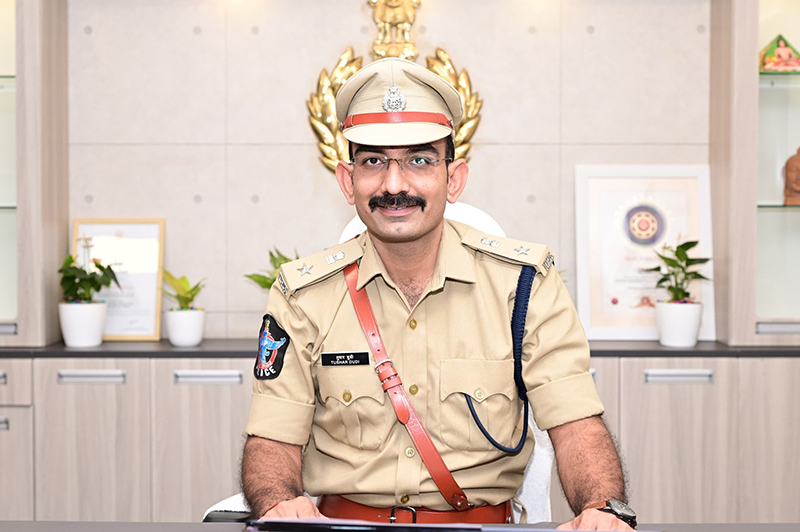
IPS Tushar Dudi a 2018 batch officer of Andhra Pradesh Cadre and currently posted as Superintendent of Police, Chittoor district has launched a community focused initiative 'Dhairya Sparsha' an effort that shifts focus from reacting to crime to addressing the spaces where it tends to originate.
The programme begins with a simple but powerful idea that crime often festers in neglected spaces. “We are focusing on small neglected spots, dark corners, abandoned buildings, underpasses, where people hesitate to go.” he explained. These areas, due to poor lighting and lack of CCTV coverage, often attract antisocial activities and slowly create fear among residents.
Under this initiative, such spots are being identified through crime data and citizen feedback. Once mapped, the transformation begins- improved lighting, installation of CCTV cameras, drone and traditional beat patrolling, repainting, repairs and visible police presence. The aim is to make these spots usable again, not merely monitored. “When a place remains dark and empty, it naturally becomes vulnerable. Our effort is to make it active and visible”
What makes the model different is its community link. After initial development, local committees are being involved so that maintenance and ownership do not remain solely with the police. Additionally depending on the nature of the location, facilities such as open gyms or basketball courts are being introduced to encourage footfall and positive public engagement. “Police cannot permanently monitor or manage these places. So we are developing these spots and gradually handing them over to local communities” he said.
Seeing the strong positive response and encouragement from people, the project which was originally planned for 15 locations has now expanded to a target of 45-50 spots. “A few spots have already been completed while more are in progress” he quoted
Dhairya Sparsha represents a shift from reactive policing to restorative policing improving the environment, turning neglected zones into vibrant public spaces and strengthening police-public trust.
Send Feedback
- HURL launches Project ‘SAKSHAM’ to empower youth through skill development (UPDATED)
- Ravi Kumar Sihag posted as Addl DC, Rajouri, J&K (UPDATED)
- Sushil Sarwan is also CEO, Sonipat Development Authority, Haryana (UPDATED)
- Reshuffle of DIG level officers in CISF (UPDATED)
- Dr Uddipan Mukherjee promoted to SAG (UPDATED)
- Appointments of five full-time Members to NITI Aayog (UPDATED)
- Ashok Kumar is Vice Chairperson, NITI Aayog (UPDATED)
- Eight IAS officers posted as Assistant Collector in MP
- Seven IPS officers get new assignments in Telangana
- Sumit Narula posted as PCSO, NFR
- Rajnish Bansal posted as CWE, NCR
- Amlan Tirkey posted as CAO (CHOD), ICF
- Vinod Kumar appointed Joint Secretary, DoD
- Randhir Sahay to continue additional charge as Dir. (Fin.), IRFC
- Sr Prog Assistant for Singapore post advertised
- DoWR, RD&GR advertised Consultant post
- CPM/GM-ISFM, Delhi post advertised by RLDA
- Last date to apply for Jt CEO, CAMPA post revised
- NHSRCL seeks AGM/JGM (RS) for Ahmedabad & New Delhi
- Dr Srivastava empanelled for appointment as IEM
- R Verma empanelled for appointment as IEM
- J N Singh & M C Borwankar empanelled for appointment as IEMs
- O P Singh empanelled for appointment as IEM
- ISRO–TIFR MoU Major New Collaboration
- 14 IDAS officers transferred
- World Heritage Day heritage walk in Telangana
- Raghvendra Singh shifted to Office of CGA
- Adll, Deputy and Asstt Commissioners' VRS accepted
- Adll, Deputy and Asstt Commissioners' VRS accepted
- UP Government not able to start the Noida International Airport
- Ms Samra appointed Interim CEO of YIAPL
- Year of Networking and Data Centricity to evolve into a Future Ready Force
- Ashok Lahiri named Vice Chairman Niti Ayog
- Alarm Bells Ring in Finance Ministry Over Advanced AI Cyber Risks
- Know the Top 4 Contenders for the Post of UN Secretary-General, in these Testing times